By Backtestle · Last updated:
What is a prop firm and how does it work?
A prop firm (proprietary trading firm) lets a trader use the firm's capital instead of their own. The trader first passes a paid evaluation (challenge), then trades the firm's account and keeps a share of the profit. This page is generated from the rule data of 33 firms and 160 programs on this site; the numbers match the firm pages.
The prop firm model in three steps
- Challenge (evaluation). You pay a fee and try to hit a profit target on a simulated account without breaching the loss limits. First-phase targets on this site range from 2% to 12%; 38 programs have no evaluation (instant funding).
- Funded account. After passing, you trade the firm's account. At most firms the money is still simulated; the firm pays your profit from its own funds. Loss limits still apply.
- Profit split (payout). At the end of a cycle a percentage of the profit is paid to you; the rest stays with the firm. Rate, payout frequency and minimum payout vary by program and are listed on the firm page.
Where does the money come from?
Most of a firm's revenue is challenge fees: most participants fail and the fee stays with the firm. Payouts to those who pass come from that pool and from the firm's own trading. That is why the rules are strict and loss limits end the most accounts (see the breach data). Treat the model as a paid exam, not an investment.
Core rules
- Profit target: the profit needed to pass a phase (percent of the starting balance).
- Daily loss limit: the most you can lose in one day; on this site it ranges from 1% to 8%, and 20 programs have none. Details: daily loss limit guide.
- Maximum loss limit: the lowest point the account may reach overall; static in 98 programs, trailing in 62. Details: trailing drawdown guide.
- Others: minimum trading days, consistency (best day) rule, news and weekend restrictions, prohibited strategies. All of them are on the program card and in the glossary.
Program types
| Type | Programs | Meaning |
|---|---|---|
| 1-Step | 71 | One evaluation: hit the target once, move to the funded account. |
| 2-Step | 46 | Two evaluations: the second phase usually has a lower target. |
| 3-Step | 3 | Three-phase evaluation. |
| Swing | 2 | Swing: positions may be held overnight and over the weekend, lower leverage. |
| Instant funding | 38 | Instant funding: no evaluation, higher fee and often a tighter trailing limit. |
The table is generated from the simulator's rule data; per-firm details are on the prop firm rules page.
Risks and things to check
- The challenge fee is not refundable; most programs refund it only with the first payout, some never.
- At most firms the funded account is simulated, not real; payouts depend on the firm's ability to pay.
- Offshore prop firms are not supervised by Turkey's Capital Markets Board (SPK); recourse in a dispute is limited.
- Rules change often; read the firm's current text before buying (the rule changes page tracks them).
- No income is guaranteed. Past performance does not predict the future; this page is not investment advice.
Before you enter a challenge
- Work through the 7 steps before a challenge; check that your strategy fits the rules.
- Pick the firm's rules in the free simulator and take at least 30 trades on available historical data under the same limits.
- Before paying, answer the which firm fits you questions and compare two firms side by side.
Frequently asked questions
Are prop firms trustworthy?
It depends on the firm. A regular payout history, clear written rules, payout proofs on independent sources and rules that do not change quietly are good signs. There is no SPK supervision in Turkey; before paying, accept that the fee can be lost.
How much does a prop firm challenge cost?
It depends on the account size and program; at the same firm a small account costs less and a large one more. Prices change often, so this page lists no figures; check the official source link on the firm pages.
Am I trading real money on a funded account?
At most firms, no: the funded account is simulated too and the firm pays profits from its own funds. Some firms copy successful traders' trades to the real market; this is stated in the contract.
What is the challenge pass rate?
Firms rarely publish it and there is no independently verified figure for Turkey. The breach data on this site shows which rule ended simulated attempts; it is not a real firm pass rate.
Try prop firm rules for free
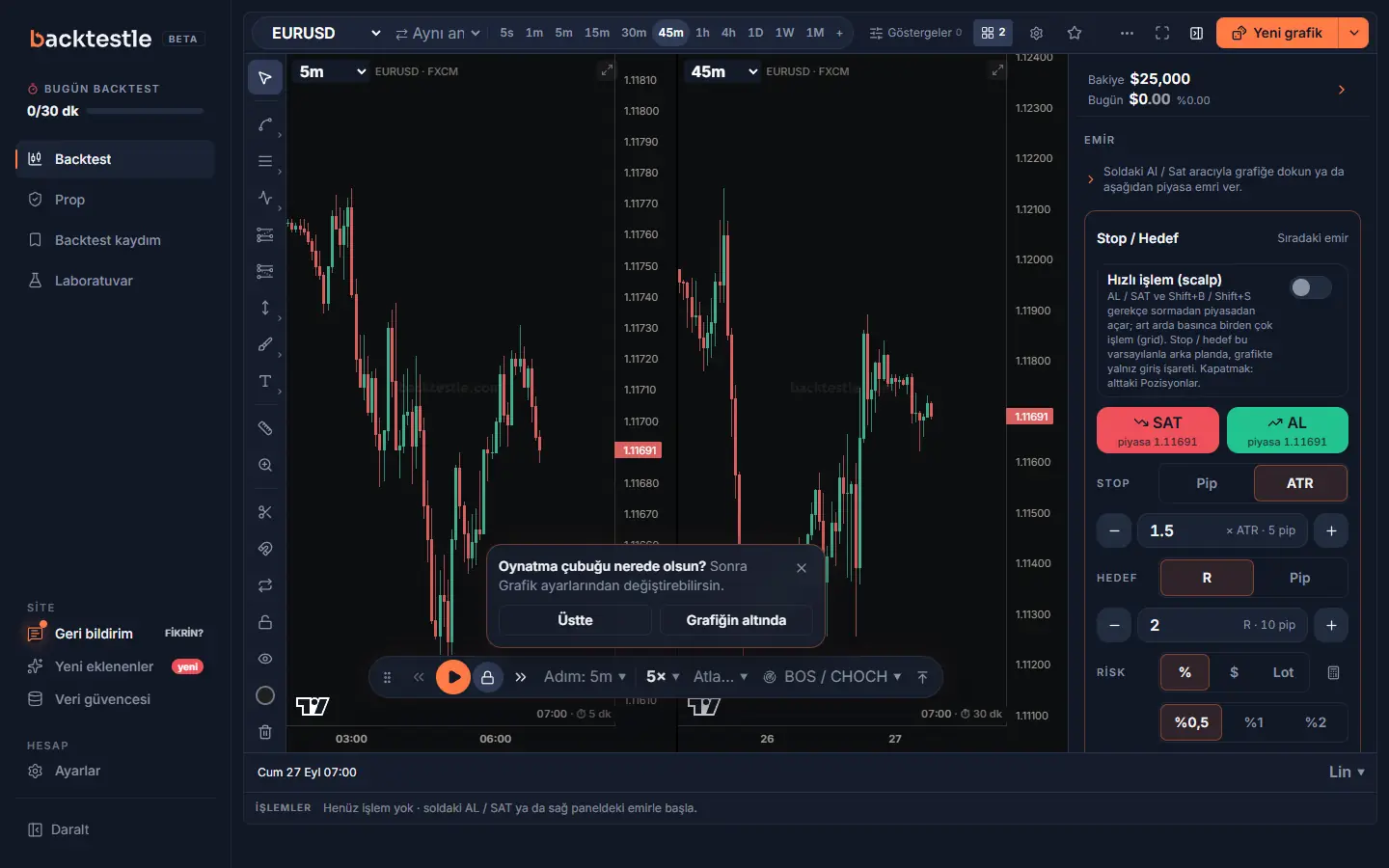
Pick a firm and program, trade available historical data with bar replay; the simulator tracks the loss limits and target with the real rules.
More guides
- How to backtest a trading strategya step-by-step manual backtesting guide
- How many trades are enough in a backtest?expectancy in R, 95% confidence interval, 30-50-100-200 trades
- How to pass a prop firm challengerisk plan and rule management
- 7 steps before a prop firm challengea prep checklist before you pay for a challenge
- Consistency rule (best day %)best day calculator, worked example and firm table
- How is the daily loss limit calculated?base (starting balance / day's opening balance), reset time, floating loss; firm table
- What are swap and spread?triple swap day, TRY pairs, swap-free, news spread, weekend gaps
- Prohibited strategies at prop firmsHFT, latency arbitrage, cross-account hedging, copy trading, trade splitting; firm table
- What is trailing drawdown?static, trailing, end-of-day trailing and locked floors; $100,000 example; program table
- Prop firms from Turkeywhich firms have a Turkey note, USD / EUR fees, payouts and identity verification
- All guidesindex and reading order
- Prop firm comparison tablerules of 33 firms
- Backtesting software compareda sourced, dated comparison with FX Replay, Forex Tester, TradingView, BacktestingMax and TradeZella
- Prop rule changelogdated, sourced rule changes and points we could not verify
- Prop firm and backtesting glossarytrailing drawdown, daily loss, R, pip, spread and more
- FAQpricing, symbols, data source and the prop simulator
Sources (last checked: October 13, 2026)
- FTMO: official rules page ↗
- BEM Funding: official rules page ↗
- Crypto Fund Trader (CFT): official rules page ↗
- Breakout (crypto): official rules page ↗
- FundedNext: official rules page ↗
- FundingPips: official rules page ↗
- E8 Markets: official rules page ↗
- The5ers: official rules page ↗
- FXIFY: official rules page ↗
- Alpha Capital Group: official rules page ↗
- Goat Funded Trader: official rules page ↗
- Atlas Funded: official rules page ↗
- Blue Guardian: official rules page ↗
- BrightFunded: official rules page ↗
- FunderPro: official rules page ↗
- City Traders Imperium (CTI): official rules page ↗
- Maven Trading: official rules page ↗
- Instant Funding: official rules page ↗
- Hola Prime: official rules page ↗
- Blueberry Funded: official rules page ↗
- AquaFunded: official rules page ↗
- For Traders: official rules page ↗
- Top One Trader: official rules page ↗
- Finotive Funding: official rules page ↗
- Audacity Capital: official rules page ↗
- Moneta Funded: official rules page ↗
- Vest Markets: official rules page ↗
- Bungee Funded Perps (crypto): official rules page ↗
- Hypernova (crypto): official rules page ↗
- Tradeify FX: official rules page ↗
- Topstep: official rules page ↗
- Apex Trader Funding: official rules page ↗
- Take Profit Trader: official rules page ↗
Last checked: October 13, 2026. Firms can change their rules; check the firm's current page before you buy. This content is for education and practice only, not investment advice; past results do not guarantee future returns.