By Backtestle · Last updated:
What is trailing drawdown and how is it calculated?
Trailing drawdown means the maximum loss limit is measured from the account's highest point (peak) rather than the starting balance: the floor rises as you profit and never falls. Of the 160 programs on this site, 62 use a trailing limit and 98 a static one; the rate ranges from 2% to 15%.
Four kinds of maximum loss limit
- Static. Floor = starting balance − limit percent. However much the account earns, the floor stays. 98 programs on this site.
- Trailing (intraday). Floor = peak equity − limit. Every new peak, open positions included, lifts the floor; even an intraday spike moves it permanently. 40 programs on this site.
- End-of-day trailing (EOD). The floor rises only with the day's closing balance; intraday peaks do not count. Softer than intraday trailing. 12 programs on this site.
- Locked. Once the floor reaches the starting balance it stops there and behaves like a static limit afterwards. 46 of the trailing programs lock.
Example ($100,000 account, 6% limit, hypothetical)
With a static limit the floor is $94,000 and stays there. With a trailing limit, if the account peaks at $104,000 the floor becomes $98,000; if you then fall to $97,000, the static account survives and the trailing one is closed. With a locked trailing limit the floor stops the moment it reaches $100,000: from then on dropping below $100,000 ends the account, anything above is free.
A few programs compute the floor as a percentage of the peak: floor = peak × (1 − limit); as the peak rises, the dollar size of the limit grows too. The program card states which definition applies.
Maximum loss limit by program
The table is generated from the simulator's rule data. Some programs use a different rate in the funded phase; see the firm page.
Common mistakes
- Treating a trailing limit as static: after an early profit given back, the account can be closed while still above the starting balance.
- Forgetting that an open position's intraday peak moves the floor (intraday trailing).
- Reading a locked floor as 'the limit is gone': the lock only stops the floor from rising, the floor is still there.
- Not checking whether the floor changes after a withdrawal: some programs recalculate it after a payout.
How to test this on the site
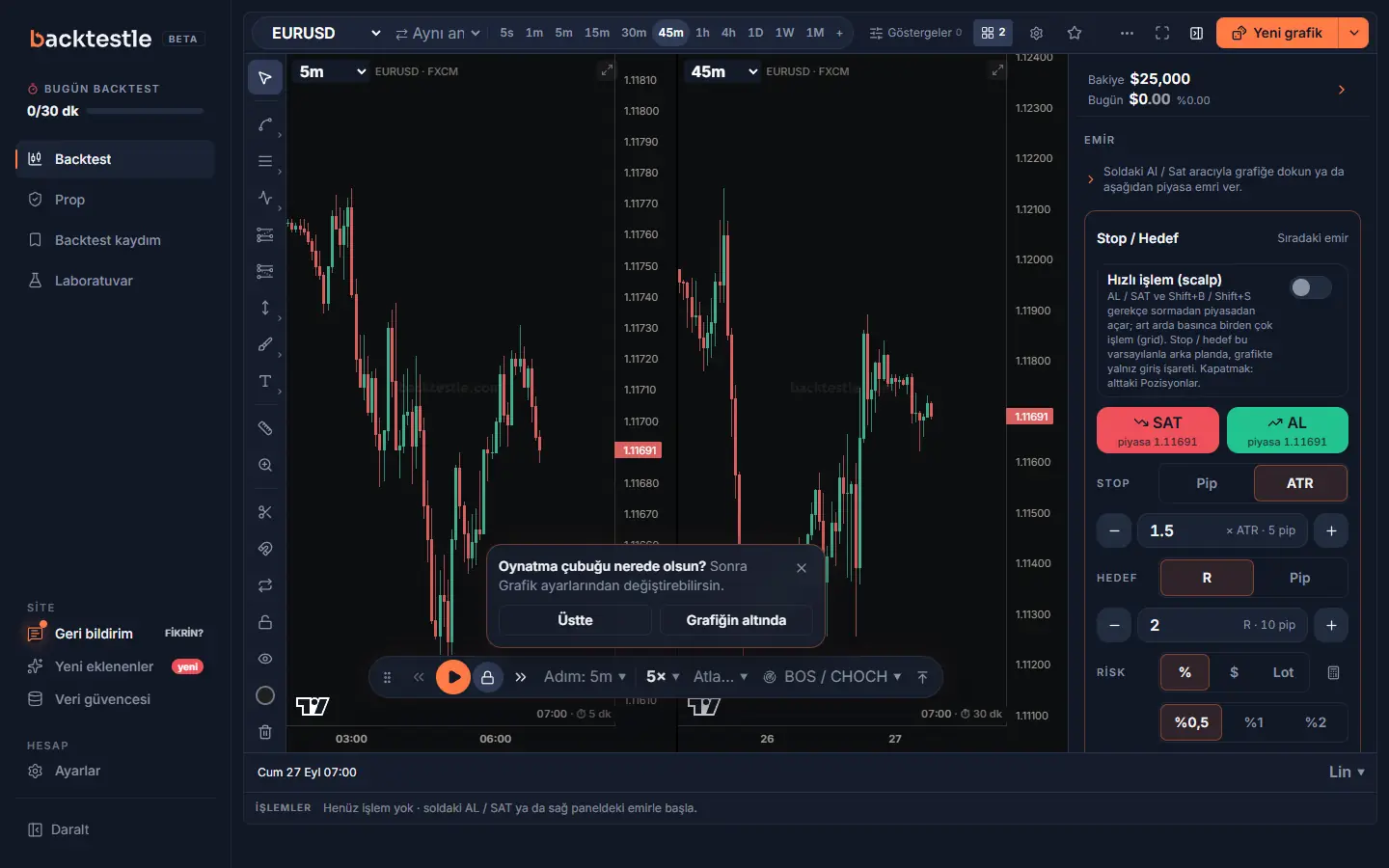
- Pick a trailing-limit program in the simulator; the rule card shows the floor and the peak live.
- Make a profit first, then give part of it back; watch how the floor has moved up.
- Run the same strategy on a static-limit program and compare the two attempts in My backtests.
Try it with your own balance path: the trailing drawdown calculator draws the floor day by day; the raw rule data is also open as JSON.
The simulator may differ from the official text in details; the firm's page has the final word. Rule changes are in the rule log, all firms on the firm rule pages. This page is not investment advice.
Frequently asked questions
What is the difference between trailing and static drawdown?
A static limit is computed once from the starting balance and never changes. A trailing limit follows the account's highest point: it rises as you profit and never falls. At the same percentage a trailing limit is always stricter.
What happens when the trailing floor reaches the starting balance?
It depends on the program. In locked programs the floor stops at the starting balance and never rises again; in unlocked programs it keeps rising with the peak. On this site 46 of the 62 trailing programs lock.
What does end-of-day (EOD) trailing mean?
The floor is recalculated only from the day's closing balance; intraday peaks do not count. Profiting and giving it back within the same day does not move the floor. 12 programs on this site use this method.
Which programs use a trailing limit?
According to the site's rule data these programs use a trailing limit: FTMO 1-Step, FTMO Instant Account (instant funding), BEM Funding BEM One · 1-Step, BEM Funding BEM One Only · 1-Step, Crypto Fund Trader (CFT) Break, Breakout (crypto) Spark ($50K only), Breakout (crypto) Spark002 ($50K only), FundedNext Stellar Instant, FundingPips 1 Step Labs001 ($100K only), FundingPips Zero (instant funding), E8 Markets E8 One, FXIFY 1-Step, FXIFY 2-Step Standard, FXIFY Lightning, FXIFY Instant funding, FXIFY Instant Funding Lite, Alpha Capital Group Alpha One · 1-Step, Alpha Capital Group Alpha One 6% · 1-Step, Alpha Capital Group Alpha One 12% · 1-Step, Alpha Capital Group Alpha Direct (instant funding), Goat Funded Trader Instant GOAT (instant funding), Goat Funded Trader Instant HERO (instant funding), Goat Funded Trader Instant Premium (instant funding), Atlas Funded Instant Funded (instant funding), Atlas Funded Instant Zero (instant funding), Atlas Funded Access (start for $5) · 1-Step, Blue Guardian 1 Step Standard, Blue Guardian 1 Step Nano, Blue Guardian Instant Standard (instant funding), BrightFunded 1-Step Daily, BrightFunded Instant (instant funding), FunderPro Instant Program (instant funding), City Traders Imperium (CTI) 1-Step, Maven Trading Standard 1-Step, Maven Trading Instant (instant funding), Instant Funding One-Phase Lite (formerly Clarity) · 1-Step, Instant Funding Evolve · 1-Step, Hola Prime Direct (instant funding), Blueberry Funded Instant Lite (instant funding), Blueberry Funded Instant Elite (instant funding), AquaFunded 1 Step Standard, AquaFunded 2 Step Pro, AquaFunded Instant Standard (instant funding), AquaFunded Instant Pro (instant funding), AquaFunded Instant Flex (instant funding), AquaFunded 1 Step Turbo · 1 phase, For Traders Pay After Pass · 1-Step, For Traders Fast · 1-Step, For Traders Instant (instant funding), For Traders Instant Pro (instant funding), Top One Trader 1-Step FLASH · 1-Step, Top One Trader 1-Step NOVA (pay after you pass) · 1-Step, Top One Trader Instant Funding (instant funding), Top One Trader Instant Prime (instant funding), Top One Trader Magnum $500K (instant funding, sınırlı süre), Moneta Funded 1-Step, Moneta Funded Instant Funding (instant funding), Moneta Funded Instant Funding Pro (instant funding), Tradeify FX Direct (instant funding), Topstep Trading Combine, Apex Trader Funding EOD Evaluation, Take Profit Trader Test. The list is generated from the simulator's data; the last check date is on each firm page.
Try a trailing limit in the free simulator
Pick a trailing-limit program, trade available historical data with bar replay and watch the floor rise on the rule card.
More guides
- How to backtest a trading strategya step-by-step manual backtesting guide
- How many trades are enough in a backtest?expectancy in R, 95% confidence interval, 30-50-100-200 trades
- How to pass a prop firm challengerisk plan and rule management
- 7 steps before a prop firm challengea prep checklist before you pay for a challenge
- Consistency rule (best day %)best day calculator, worked example and firm table
- How is the daily loss limit calculated?base (starting balance / day's opening balance), reset time, floating loss; firm table
- What are swap and spread?triple swap day, TRY pairs, swap-free, news spread, weekend gaps
- Prohibited strategies at prop firmsHFT, latency arbitrage, cross-account hedging, copy trading, trade splitting; firm table
- What is a prop firm and how does it work?challenge, funded account, profit split, rules, risks; firm and program counts from code
- Prop firms from Turkeywhich firms have a Turkey note, USD / EUR fees, payouts and identity verification
- All guidesindex and reading order
- Prop firm comparison tablerules of 33 firms
- Backtesting software compareda sourced, dated comparison with FX Replay, Forex Tester, TradingView, BacktestingMax and TradeZella
- Prop rule changelogdated, sourced rule changes and points we could not verify
- Prop firm and backtesting glossarytrailing drawdown, daily loss, R, pip, spread and more
- FAQpricing, symbols, data source and the prop simulator
Sources (last checked: October 13, 2026)
- FTMO: official rules page ↗
- BEM Funding: official rules page ↗
- Crypto Fund Trader (CFT): official rules page ↗
- Breakout (crypto): official rules page ↗
- FundedNext: official rules page ↗
- FundingPips: official rules page ↗
- E8 Markets: official rules page ↗
- The5ers: official rules page ↗
- FXIFY: official rules page ↗
- Alpha Capital Group: official rules page ↗
- Goat Funded Trader: official rules page ↗
- Atlas Funded: official rules page ↗
- Blue Guardian: official rules page ↗
- BrightFunded: official rules page ↗
- FunderPro: official rules page ↗
- City Traders Imperium (CTI): official rules page ↗
- Maven Trading: official rules page ↗
- Instant Funding: official rules page ↗
- Hola Prime: official rules page ↗
- Blueberry Funded: official rules page ↗
- AquaFunded: official rules page ↗
- For Traders: official rules page ↗
- Top One Trader: official rules page ↗
- Finotive Funding: official rules page ↗
- Audacity Capital: official rules page ↗
- Moneta Funded: official rules page ↗
- Vest Markets: official rules page ↗
- Bungee Funded Perps (crypto): official rules page ↗
- Hypernova (crypto): official rules page ↗
- Tradeify FX: official rules page ↗
- Topstep: official rules page ↗
- Apex Trader Funding: official rules page ↗
- Take Profit Trader: official rules page ↗
Last checked: October 13, 2026. Firms can change their rules; check the firm's current page before you buy. This content is for education and practice only, not investment advice; past results do not guarantee future returns.