By Backtestle · Last updated:
7 steps before a prop firm challenge
Most of the work before paying for a challenge is rule knowledge and discipline. This list uses the site's tools so you can see rule breaches in advance and follow the account step by step. No tool guarantees a pass; the simulator is a practice space on historical data. For risk and rule management during the challenge: how to pass a prop firm challenge
1. Read your program's rule card
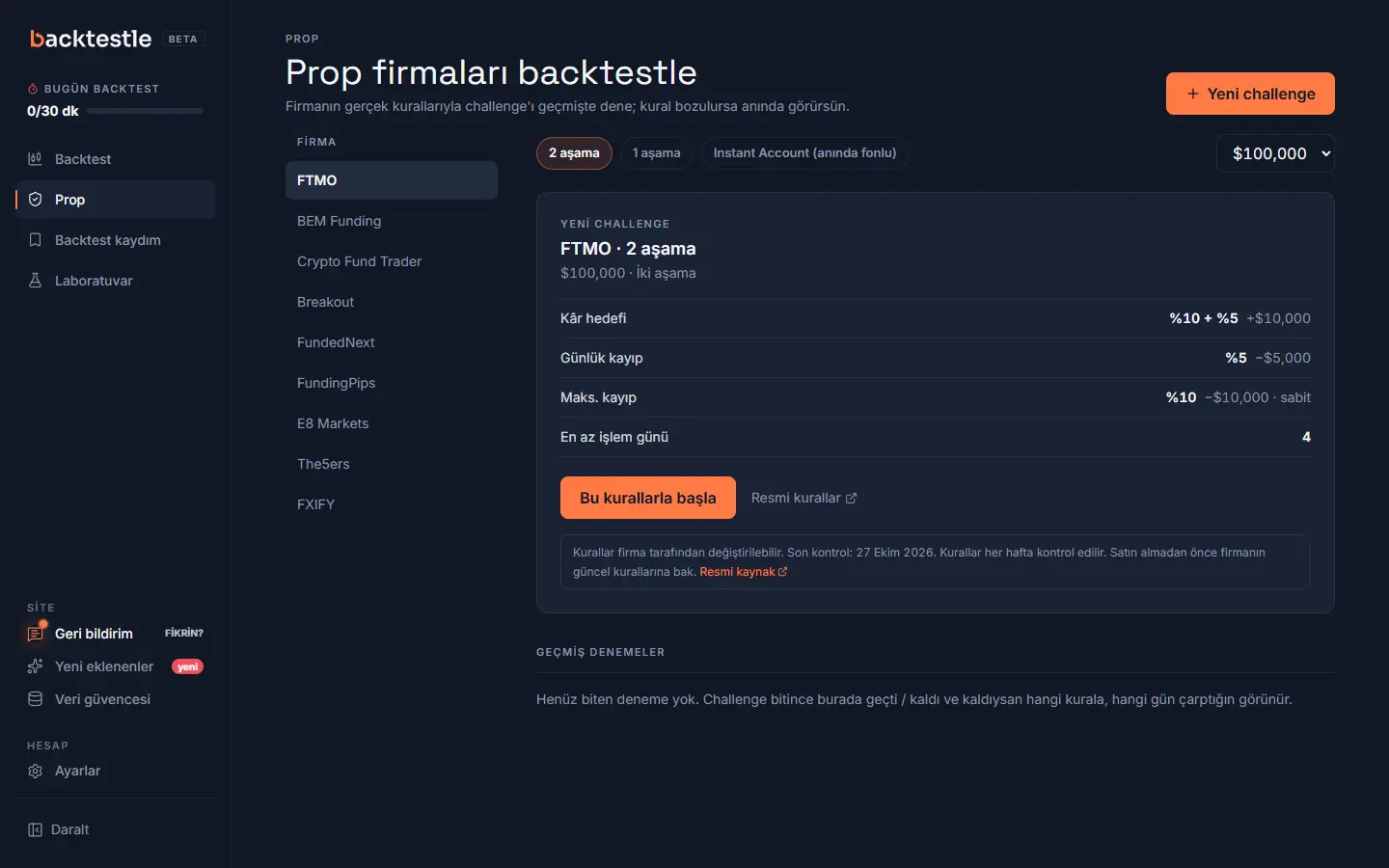
Pick the firm and program and note on the rule card: profit target, daily loss (and what it's based on), max loss type (static, trailing, end-of-day trailing), minimum trading days, news and weekend rules, the consistency rule and the daily reset time. Firm rule tables: prop firm comparison. Even programs at the same firm differ (FTMO 2-step vs 1-step), so pick the program first. Each card links to the official rules page; the firm has the final say.
2. Work your risk back from the limits
If the daily limit is 5%, set risk per trade so you can absorb several losses in a row that day. Do the math from your own limit: compare how many consecutive losses it takes to hit it at 0.5% vs 1% risk. Your longest losing streak × risk per trade should stay under half the max loss limit. Set the risk % and account size on the simulator's Account card.
3. Run practice challenges with the same rules
Open the simulator, pick the program and trade historical data with bar replay. Orders that would break a rule are flagged in advance; if a limit is breached the account ends like the real thing. Run at least 3-5 challenges per program; see how many you pass and which rule stops you.
4. Read the post-mortem of failed attempts
When an attempt ends, the "Why?" card shows which rule ended it, on which day, on which trade and by how much (My backtests). If the same rule keeps ending your attempts, the problem is the risk plan, not the strategy.
5. Strategy scorecard and Monte Carlo
Your strategy gets a scorecard grade after at least 30 trades. Monte Carlo shuffles your trades and shows the chance of hitting the limit in different orders. For how many trades you need, see how many trades are enough in a backtest? Monte Carlo assumes the distribution of your past trades; it does not predict the future.
6. Run a session test
Run your strategy separately in the London, New York and Asian sessions (the "Stop at session open" chart setting pauses replay on the session's opening candle). See in which session the average R flips sign and plan the challenge around the session that suits you. Note: splitting 30 trades across 3 sessions leaves 10 per session; small samples mislead.
7. Write down your news, weekend and cost plan
Put the program's news window and weekend rule on your calendar. Enter spread, commission and stop slippage on the simulator's Account card; without them a backtest looks better than a real account. Trying small lot sizes before going live is one way to limit risk.
What this list doesn't do
- It doesn't guarantee you'll pass the challenge.
- It doesn't model the firms' identity verification, compliance, payout or account approval processes; those are firm procedures, not rules.
- The simulator's swap (overnight interest) and stop slippage are estimates: swap is derived from the interest rate differential and slippage from spread widening; a real account's costs can differ.
Frequently asked questions
What should I do before starting a challenge?
Read the program's rules, work your risk back from the daily and max loss limits, try your strategy a few times in the simulator with the same rules and read the post-mortem of failed attempts. This list covers that in seven steps.
Does the simulator guarantee I'll pass the challenge?
No. The simulator lets you see rule breaches in advance and follow the account step by step; results on historical data don't guarantee future results, and firms can change their rules.
How many attempts should I run?
At least 3-5 attempts per program are recommended; a single attempt can't tell skill from luck. For a sturdier view, look at the strategy scorecard and Monte Carlo too.
Practice the challenge in a free simulator first
Pick a firm and program, trade available historical data with bar replay and see which rule stops you.
Terms in this guide
See the glossary for a short definition and a worked example.
More guides
- How to backtest a trading strategya step-by-step manual backtesting guide
- How many trades are enough in a backtest?expectancy in R, 95% confidence interval, 30-50-100-200 trades
- How to pass a prop firm challengerisk plan and rule management
- Consistency rule (best day %)best day calculator, worked example and firm table
- How is the daily loss limit calculated?base (starting balance / day's opening balance), reset time, floating loss; firm table
- What are swap and spread?triple swap day, TRY pairs, swap-free, news spread, weekend gaps
- Prohibited strategies at prop firmsHFT, latency arbitrage, cross-account hedging, copy trading, trade splitting; firm table
- What is a prop firm and how does it work?challenge, funded account, profit split, rules, risks; firm and program counts from code
- What is trailing drawdown?static, trailing, end-of-day trailing and locked floors; $100,000 example; program table
- Prop firms from Turkeywhich firms have a Turkey note, USD / EUR fees, payouts and identity verification
- All guidesindex and reading order
- Prop firm comparison tablerules of 33 firms
- Backtesting software compareda sourced, dated comparison with FX Replay, Forex Tester, TradingView, BacktestingMax and TradeZella
- Prop rule changelogdated, sourced rule changes and points we could not verify
- Prop firm and backtesting glossarytrailing drawdown, daily loss, R, pip, spread and more
- FAQpricing, symbols, data source and the prop simulator
Sources (last checked: October 13, 2026)
- FTMO: official rules page ↗
- BEM Funding: official rules page ↗
- Crypto Fund Trader (CFT): official rules page ↗
- Breakout (crypto): official rules page ↗
- FundedNext: official rules page ↗
- FundingPips: official rules page ↗
- E8 Markets: official rules page ↗
- The5ers: official rules page ↗
- FXIFY: official rules page ↗
- Alpha Capital Group: official rules page ↗
- Goat Funded Trader: official rules page ↗
- Atlas Funded: official rules page ↗
- Blue Guardian: official rules page ↗
- BrightFunded: official rules page ↗
- FunderPro: official rules page ↗
- City Traders Imperium (CTI): official rules page ↗
- Maven Trading: official rules page ↗
- Instant Funding: official rules page ↗
- Hola Prime: official rules page ↗
- Blueberry Funded: official rules page ↗
- AquaFunded: official rules page ↗
- For Traders: official rules page ↗
- Top One Trader: official rules page ↗
- Finotive Funding: official rules page ↗
- Audacity Capital: official rules page ↗
- Moneta Funded: official rules page ↗
- Vest Markets: official rules page ↗
- Bungee Funded Perps (crypto): official rules page ↗
- Hypernova (crypto): official rules page ↗
- Tradeify FX: official rules page ↗
- Topstep: official rules page ↗
- Apex Trader Funding: official rules page ↗
- Take Profit Trader: official rules page ↗
Last checked: October 13, 2026. Firms can change their rules; check the firm's current page before you buy. This content is for education and practice only, not investment advice; past results do not guarantee future returns.