By Backtestle · Last updated:
How to pass a prop firm challenge
A prop firm challenge (evaluation) asks you to reach a profit target without breaching the daily and overall loss limits. Most challenges end not because the strategy is bad, but because a rule was missed or risk wasn't sized to the limits. The steps below apply to FTMO, FundedNext, FundingPips, The5ers, FXIFY, E8 Markets and other firms. Nothing here guarantees a pass.
How does a prop firm challenge work?
A challenge is an exam on virtual capital provided by the firm. You reach a profit target without breaking the loss limits.
Depending on the program there are one, two or three phases. After you pass, a funded account opens and you get a share of the profit.
The rules fall into three groups. The profit target, the loss limits (daily and overall) and conduct rules (news, weekends, minimum trading days, consistency). Breaking a loss limit once usually ends the account immediately.
1. Learn the rules of your program
Even programs at the same firm differ: FTMO 2-step has a static 10% max loss, while 1-step has a 10% end-of-day trailing max loss and a 3% daily loss limit. Write down the profit target, what the daily loss limit is based on (starting balance or the day's opening balance), the max loss type, minimum trading days, and the news and weekend rules.
2. Work your risk back from the limits
If the daily limit is 5%, 3-4 losses in a row should stop you for the day, not end the account. Most traders risk 0.5-1% per trade. Your longest losing streak × risk per trade should stay under half the max loss limit.
3. Test your strategy in the simulator with the same rules
A strategy that is profitable in a backtest can still blow a challenge because of the daily limit or trailing drawdown. Run at least 3-5 challenges on historical data with your program's rules; see how many you pass and which rule stops you.
4. Plan for news and weekends
At some firms, profit from trades opened a few minutes before / after high-impact news is removed or the account is breached; at others you cannot hold positions over the weekend on a funded account. Add the economic calendar to your trading plan.
5. Focus on the rules, not the target
Raising lot size near the target and revenge trading after a loss are the most common reasons challenges end. If there is a minimum trading days rule, you have time: keep risk fixed.
6. Check the consistency rule
In some programs your best day cannot exceed a set share of total profit (e.g. 30-50%). Reaching the target with one big day does not complete the evaluation in those programs.
How the consistency rule is calculated and which programs use it: consistency rule (best day %). To prepare before you pay for a challenge: 7 steps before a challenge.
How do you size risk per trade from the limits?
Work out risk from the limits, not from the target. Example: the daily limit is 5% and you plan at most 4 losses in a day. Then risk per trade is at most 1.25%. The overall limit is 10% and your longest backtest losing streak is 5 trades. That streak should not exceed half the overall limit: risk at most 1%. The smaller of the two, 1%, is your ceiling.
What does a sample challenge run look like day by day?
Below is a sample 10-day run. The rules are read from the site's rule table; the trade results are an example. Each row shows how much room was left at the worst moment of the day.
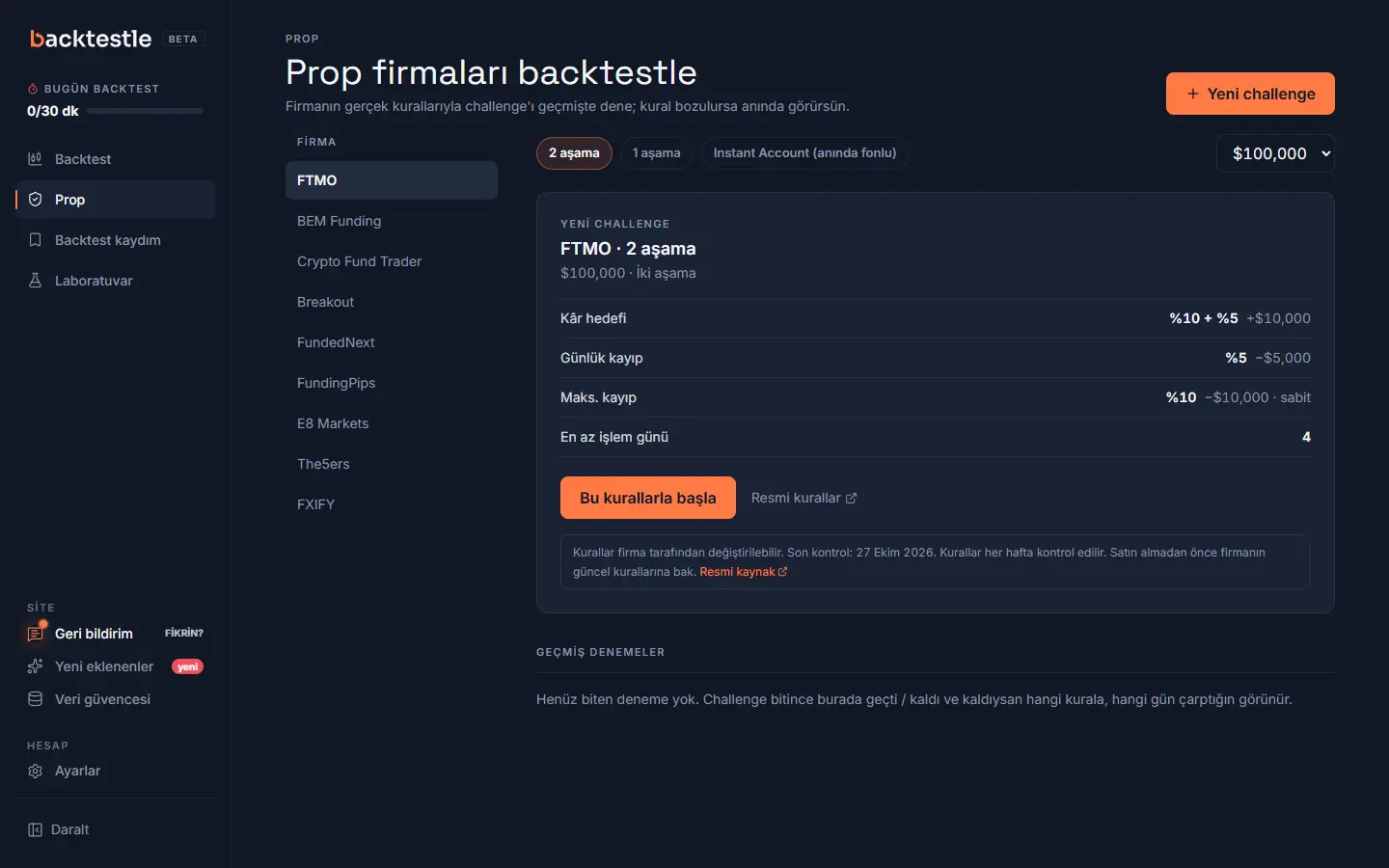
Sample program FTMO · 2-Step, account $100,000. Target 10%, daily loss 5%, maximum loss 10%, at least 4 trading days. Risk per trade 1% (1R).
| Day | Trades | Day result | End-of-day balance | Left to daily limit | Left to max loss | Left to target |
|---|---|---|---|---|---|---|
| 1 | +2R | +2% | $102,000 | 5% | 10% | 8% |
| 2 | -1R · -1R | -2% | $100,000 | 3% | 10% | 10% |
| 3 | +2R · -1R | +1% | $101,000 | 5% | 10% | 9% |
| 4 | -1R · -1R · -1R | -3% | $98,000 | 2% | 8% | 12% |
| 5 | +2R · +2R | +4% | $102,000 | 5% | 8% | 8% |
| 6 | -1R | -1% | $101,000 | 4% | 11% | 9% |
| 7 | +2R · -1R · +2R | +3% | $104,000 | 5% | 11% | 6% |
| 8 | -1R · -1R | -2% | $102,000 | 3% | 12% | 8% |
| 9 | +2R · +2R | +4% | $106,000 | 5% | 12% | 4% |
| 10 | +2R · +2R | +4% | $110,000 | 5% | 16% | Reached |
The target was reached on day 10. The hardest day was day 4: after three losses, 2% was left to the daily limit. The plan said 'stop after three losses', so the day ended there.
Played with 2% risk, the same trades would have breached the daily loss limit on day 4. Same strategy, different outcome: risk makes the difference.
What goes into a sample trade journal?
The first 8 trades of the run are below. Each result is recorded in R. The note column helps separate a rule problem from a strategy problem.
| # | Day | Symbol | Side | Result | Total | Note |
|---|---|---|---|---|---|---|
| 1 | 1 | EURUSD | Long | +2.0R | +2.0R | Within plan, 2R target. |
| 2 | 2 | XAUUSD | Short | -1.0R | +1.0R | First loss of the day. |
| 3 | 2 | EURUSD | Long | -1.0R | 0.0R | Second loss; no other setup that day. |
| 4 | 3 | GBPUSD | Long | +2.0R | +2.0R | Clean setup, 2R target. |
| 5 | 3 | XAUUSD | Short | -1.0R | +1.0R | Loss; the day still closed positive. |
| 6 | 4 | EURUSD | Short | -1.0R | 0.0R | First loss; risk unchanged. |
| 7 | 4 | XAUUSD | Long | -1.0R | -1.0R | Second loss; size not increased. |
| 8 | 4 | GBPUSD | Short | -1.0R | -2.0R | Third loss: day closed per the plan. |
Why is trailing drawdown harder?
With a static maximum loss the floor never moves. With a $100,000 start and a 10% limit, the floor is $90,000.
With trailing drawdown the floor rises with the highest balance reached. As you move into profit, your margin for error does not grow.
Some firms trail the floor from the end-of-day balance, others from the intraday peak. Intraday trailing is stricter. Check which type applies on the firm's rule page.
Why do challenges fail most often?
- Daily loss limit: consecutive losses on one bad day.
- Increasing size as the target gets close.
- Revenge trading after a loss.
- Not knowing the news window or the weekend rule.
- Confusing what the daily limit is based on (balance or equity).
What changes after you pass the challenge?
The funded account drops the profit target, but the loss limits remain. At some firms, news and weekend rules only start on the funded account.
Payouts may require a consistency rule or minimum trading days. These conditions differ from program to program.
Keep the challenge risk plan on the funded account. The fastest way to lose the account is to raise risk after passing.
Firm rules
Full rule tables for each firm's programs: FTMO, BEM Funding, Crypto Fund Trader (CFT), Breakout (crypto), FundedNext, FundingPips, E8 Markets, The5ers, FXIFY, Alpha Capital Group, Goat Funded Trader, Atlas Funded, Blue Guardian, BrightFunded, FunderPro, City Traders Imperium (CTI), Maven Trading, Instant Funding, Hola Prime, Blueberry Funded, AquaFunded, For Traders, Top One Trader, Finotive Funding, Audacity Capital, Moneta Funded, Vest Markets, Bungee Funded Perps (crypto), Hypernova (crypto), Tradeify FX, Topstep, Apex Trader Funding, Take Profit Trader. All in one place: prop firm comparison table.
Practice the challenge in a free simulator first
Pick a firm and program, then trade available historical data with bar replay. Orders that would break a rule are flagged in advance; if a limit is breached the account ends like the real thing and you see which rule did it.
Terms in this guide
See the glossary for a short definition and a worked example.
- Challenge (evaluation)
- Funded account
- Drawdown
- Max loss
- Static drawdown
- Trailing drawdown
- Daily loss limit
- Minimum trading days
- Risk per trade
- Balance and equity
More guides
- How to backtest a trading strategya step-by-step manual backtesting guide
- How many trades are enough in a backtest?expectancy in R, 95% confidence interval, 30-50-100-200 trades
- 7 steps before a prop firm challengea prep checklist before you pay for a challenge
- Consistency rule (best day %)best day calculator, worked example and firm table
- How is the daily loss limit calculated?base (starting balance / day's opening balance), reset time, floating loss; firm table
- What are swap and spread?triple swap day, TRY pairs, swap-free, news spread, weekend gaps
- Prohibited strategies at prop firmsHFT, latency arbitrage, cross-account hedging, copy trading, trade splitting; firm table
- What is a prop firm and how does it work?challenge, funded account, profit split, rules, risks; firm and program counts from code
- What is trailing drawdown?static, trailing, end-of-day trailing and locked floors; $100,000 example; program table
- Prop firms from Turkeywhich firms have a Turkey note, USD / EUR fees, payouts and identity verification
- All guidesindex and reading order
- Prop firm comparison tablerules of 33 firms
- Backtesting software compareda sourced, dated comparison with FX Replay, Forex Tester, TradingView, BacktestingMax and TradeZella
- Prop rule changelogdated, sourced rule changes and points we could not verify
- Prop firm and backtesting glossarytrailing drawdown, daily loss, R, pip, spread and more
- FAQpricing, symbols, data source and the prop simulator
This page is for education only and is not investment advice.
Sources (last checked: October 13, 2026)
- FTMO: official rules page ↗
- BEM Funding: official rules page ↗
- Crypto Fund Trader (CFT): official rules page ↗
- Breakout (crypto): official rules page ↗
- FundedNext: official rules page ↗
- FundingPips: official rules page ↗
- E8 Markets: official rules page ↗
- The5ers: official rules page ↗
- FXIFY: official rules page ↗
- Alpha Capital Group: official rules page ↗
- Goat Funded Trader: official rules page ↗
- Atlas Funded: official rules page ↗
- Blue Guardian: official rules page ↗
- BrightFunded: official rules page ↗
- FunderPro: official rules page ↗
- City Traders Imperium (CTI): official rules page ↗
- Maven Trading: official rules page ↗
- Instant Funding: official rules page ↗
- Hola Prime: official rules page ↗
- Blueberry Funded: official rules page ↗
- AquaFunded: official rules page ↗
- For Traders: official rules page ↗
- Top One Trader: official rules page ↗
- Finotive Funding: official rules page ↗
- Audacity Capital: official rules page ↗
- Moneta Funded: official rules page ↗
- Vest Markets: official rules page ↗
- Bungee Funded Perps (crypto): official rules page ↗
- Hypernova (crypto): official rules page ↗
- Tradeify FX: official rules page ↗
- Topstep: official rules page ↗
- Apex Trader Funding: official rules page ↗
- Take Profit Trader: official rules page ↗
- Investopedia: What is drawdown? ↗
- Investopedia: Position sizing ↗
Last checked: October 13, 2026. Firms can change their rules; check the firm's current page before you buy. This content is for education and practice only, not investment advice; past results do not guarantee future returns.